Small Business Relief extended to 2029, a new R&D tax credit of up to 50%, a 15% minimum tax for large groups and a rewritten penalty regime. A plain-English guide to where UAE corporate tax stands and what to do about it.
Key points
- The headline rate has not changed: 0% up to AED 375,000 of taxable income and 9% above it.
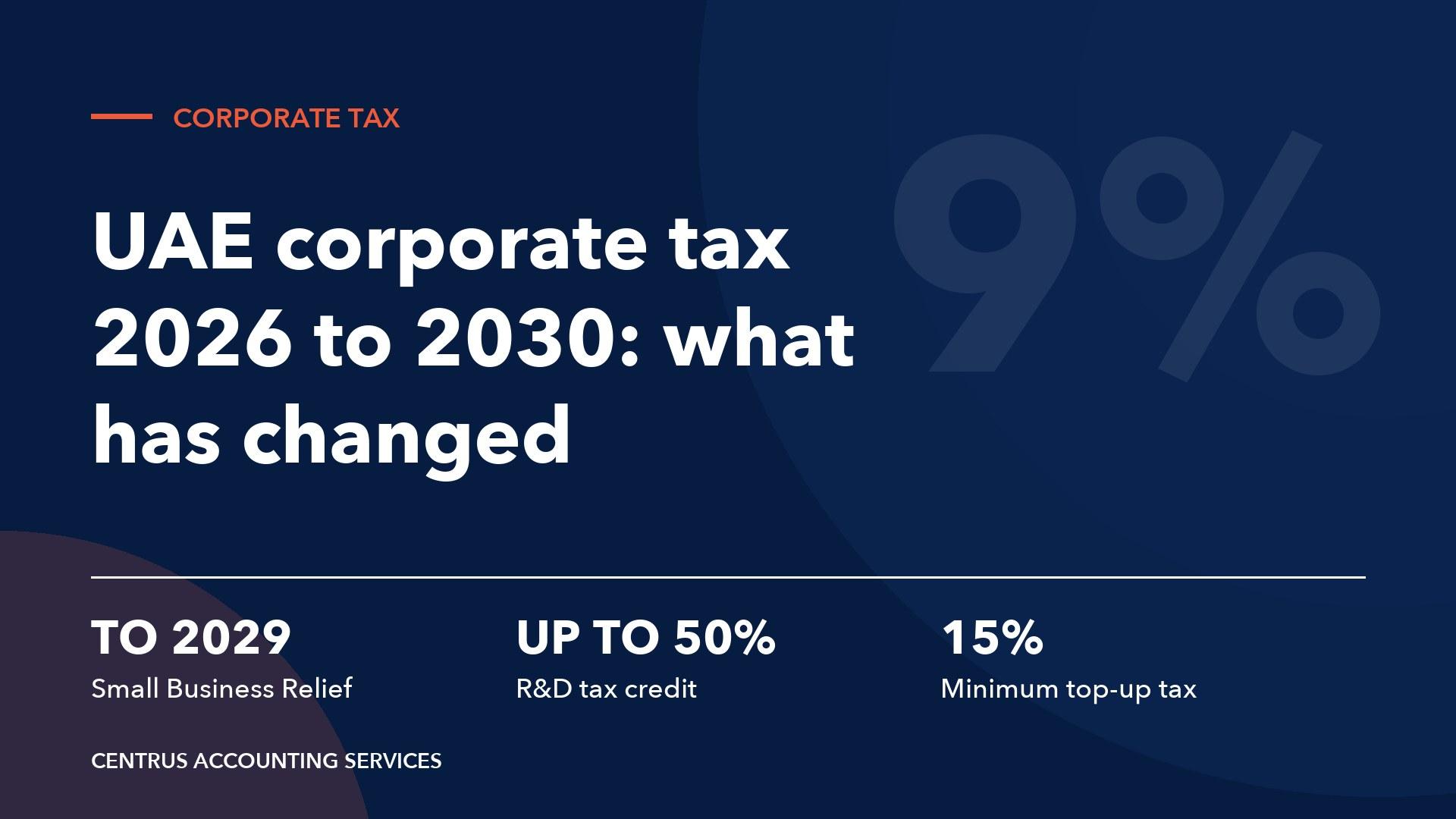
- Small Business Relief has been extended to tax periods ending on or before 31 December 2029, for businesses with revenue of AED 3 million or less.
- A new R&D tax credit of up to 50% applies to tax periods starting on or after 1 January 2026.
- Large multinational groups now face a 15% Domestic Minimum Top-up Tax.
- A new penalty regime has applied since 14 April 2026, with late payment charged at 14% a year.
UAE corporate tax is now in its third year. The first returns have been filed, the Federal Tax Authority (FTA) has data on how businesses behave, and the rules have moved a long way from the original 2022 law. This article brings together what has changed and what a business should plan for between now and 2030.
Where corporate tax stands today
Corporate tax was introduced by Federal Decree-Law No. 47 of 2022 and applies to financial years starting on or after 1 June 2023. Taxable income up to AED 375,000 is taxed at 0%, and income above that at 9%. Qualifying Free Zone Persons can still benefit from a 0% rate on qualifying income, subject to strict conditions.
The tax is now a significant source of public revenue. Figures reported from the FTA show collections of about AED 46.5 billion for tax periods ending in 2025, up 33.9% from about AED 34.75 billion the year before, and roughly AED 81 billion since the tax began.
AED billions
Source: Federal Tax Authority figures as reported by Arabian Business.
Compliance is improving too. The share of corporate tax returns filed on time rose from 87% in 2025 to 91% in 2026, and more than 650,000 businesses were registered for corporate tax by late 2025.
Source: Federal Tax Authority figures as reported by Arabian Business.
The message from these numbers is that the grace period is over. The FTA has the registrations, the returns and, from 2027, transaction-level e-invoicing data to check them against.
1. Small Business Relief runs to 2029
Small Business Relief lets an eligible business elect to be treated as having no taxable income for a tax period, so it pays no corporate tax and files a simplified return. It was due to end for tax periods ending after 31 December 2026.
Ministerial Decision No. 131 of 2026 extended it. The relief is now available for tax periods ending on or before 31 December 2029. The revenue ceiling stays at AED 3 million.
Conditions to check
- You must be a UAE resident person.
- Revenue must be AED 3 million or less in the current tax period and in every previous tax period. Exceed it once and the relief is no longer available.
- Qualifying Free Zone Persons and members of large multinational groups (consolidated revenue of AED 3.15 billion or more) cannot use it.
- It is not automatic. You elect for it in your corporate tax return each year.
- The FTA can deny the relief where a business has been artificially split to stay under the limit.
Registration and filing still apply. A business using the relief must be registered for corporate tax and must file a return within nine months of its year end.
2. A tax credit for research and development
Cabinet Decision No. 215 of 2025 and Ministerial Decision No. 24 of 2026 introduced the UAE's first R&D tax credit, effective for tax periods starting on or after 1 January 2026. The credit is tiered by the amount of qualifying spending and the size of the R&D team.
| Qualifying R&D expenditure | Credit rate | Minimum average R&D staff |
|---|---|---|
| First AED 1 million | 15% | 2 |
| Above AED 1 million, up to AED 2 million | 35% | 6 |
| Above AED 2 million, up to AED 5 million | 50% | 14 |
Source: Cabinet Decision No. 215 of 2025 and Ministerial Decision No. 24 of 2026, as summarised by EY.
On the maximum AED 5 million of qualifying spending that gives a credit of AED 2 million per entity per tax period (AED 150,000, plus AED 350,000, plus AED 1.5 million).
What to know before you claim
- The work must be physically carried out in the UAE and meet the definition of R&D in the OECD Frascati Manual.
- Each project needs at least AED 500,000 of qualifying expenditure.
- Pre-approval is mandatory. Projects must be approved by the competent authority before a claim is made.
- The credit is non-refundable. It is set against corporate tax or top-up tax, and unused amounts can generally be carried forward.
- Records must be kept for seven years, and credits can be clawed back if conditions are later breached.
The Ministry of Finance has described this as a first phase. Businesses in technology, manufacturing, life sciences and engineering should start tracking R&D staff time and project costs now, because a claim depends on evidence gathered during the year, not afterwards.
3. A 15% minimum tax for large multinationals
Cabinet Decision No. 142 of 2024 introduced a Domestic Minimum Top-up Tax (DMTT) in line with the OECD's Pillar Two rules. It applies to financial years starting on or after 1 January 2025.
- Who: UAE entities of multinational groups with consolidated revenue of €750 million or more in at least two of the previous four financial years.
- What: a top-up so that the group's effective tax rate in the UAE is at least 15%.
- Return: due 15 months after the financial year end, extended to 18 months for the first year.
- Registration: under FTA Decision No. 12 of 2026, generally within seven months of the end of the first in-scope financial year. For financial years that ended before 30 April 2026 the deadline is 30 November 2026.
- Safe harbours: a transitional country-by-country reporting safe harbour can reduce the top-up tax to zero for early years where its tests are met.
This does not affect most UAE businesses directly. It does affect UAE subsidiaries of large foreign groups, including many in free zones that have been paying 0%. Those entities should not assume their free zone status settles the matter.
4. A simpler, and in places lighter, penalty regime
Cabinet Decision No. 129 of 2025 rewrote the administrative penalties for tax violations with effect from 14 April 2026. Its main effect was to bring VAT and excise tax penalties into line with the corporate tax model.
| Area | Before 14 April 2026 (VAT and excise) | From 14 April 2026 |
|---|---|---|
| Late payment of tax | 2% immediately, then 4% each month, up to 300% of the unpaid tax | 14% a year, calculated monthly on the unpaid tax |
| Voluntary disclosure | Fixed bands of 5% to 40%, depending on how late the disclosure was made | 1% of the tax difference for each month, or part of a month, from the due date to the date of disclosure |
Corporate tax already used a 14% annual late payment penalty. The fixed corporate tax penalties most businesses meet in practice remain as follows.
| Violation | Penalty |
|---|---|
| Late corporate tax registration | AED 10,000 |
| Late filing of a return | AED 500 a month for the first 12 months, then AED 1,000 a month |
| Late payment | 14% a year on the unpaid tax |
The FTA has waived the AED 10,000 late registration penalty for businesses that file their first return within seven months of the end of their first tax period. If you registered late and that window is still open, use it.
The lesson of the new regime is that correcting an error early is now clearly cheaper than waiting. A voluntary disclosure made within a few months costs a few per cent of the tax; one made after an FTA audit has started costs much more.
5. Audited financial statements
Under Ministerial Decision No. 84 of 2025, which applies to tax periods starting on or after 1 January 2025, the following must prepare and keep audited financial statements for corporate tax purposes:
- a taxable person with revenue above AED 50 million in the tax period;
- every Qualifying Free Zone Person, whatever its size;
- tax groups, which must prepare audited special purpose financial statements.
A free zone company that claims the 0% rate without audited accounts risks losing its qualifying status and being taxed at 9% for five years. Book your auditor well before the filing deadline. See our external audit service.
6. Time limits on refunds and credits
Federal Decree-Law No. 17 of 2025 amended the Tax Procedures Law from 1 January 2026. A taxpayer now has five years from the end of the relevant tax period to claim a refund or use a credit balance. After that the right lapses. A one-year transitional window, ending on 31 December 2026, lets businesses claim older balances that would otherwise already have expired.
If your VAT account shows an old credit you have been carrying forward, review it before the end of 2026.
What to do by size of business
| Your business | Priorities for 2027 |
|---|---|
| Revenue up to AED 3 million | Decide each year whether to elect for Small Business Relief or preserve losses. File on time. Watch the AED 3 million ceiling. |
| Revenue AED 3 million to AED 50 million | Get the tax computation right: disallowed expenses, related-party transactions, interest limits. Prepare for e-invoicing on 1 July 2027. |
| Revenue above AED 50 million | Audited financial statements, transfer pricing documentation, e-invoicing live on 1 January 2027. |
| Qualifying Free Zone Person | Audited accounts every year, substance in the zone, monitor non-qualifying income against the de minimis limit. |
| Part of a group above €750 million | DMTT registration and return, safe harbour analysis, data for effective tax rate calculations. |
Key dates
| Date | What is due |
|---|---|
| 30 November 2026 | DMTT registration for in-scope groups whose financial year ended before 30 April 2026 |
| 31 December 2026 | End of the transitional window for claiming older refunds and credit balances |
| 30 September 2027 | Corporate tax return and payment for financial years ended 31 December 2026 |
| 31 December 2029 | Last tax period end date for which Small Business Relief can be elected |
How Centrus can help
We prepare and file corporate tax returns, advise on Small Business Relief and free zone status, support R&D credit claims, and help correct past errors through voluntary disclosure. Read more about our corporate tax advisory service or speak to our team.
Sources and further reading
- UAE Ministry of Finance: Domestic Minimum Top-up Tax
- EY: UAE issues Research and Development Tax Credit legislation
- EY: UAE issues Domestic Minimum Top-up Tax legislation
- KPMG: UAE releases registration requirements for Domestic Minimum Top-up Tax
- Entrepreneur Middle East: UAE extends Small Business Tax Relief through 2029
- Al Tamimi & Company: UAE introduces comprehensive tax penalty reform, effective 14 April 2026
- Baker McKenzie: New Federal Decree-Laws amending the VAT Law and Tax Procedures Law
- Arabian Business: UAE collects $12.7bn in corporate tax as revenues jump 33.9%
This article is general information, not professional advice. UAE tax and regulatory rules change, so confirm the current position with the Federal Tax Authority or speak to our team before acting on it.