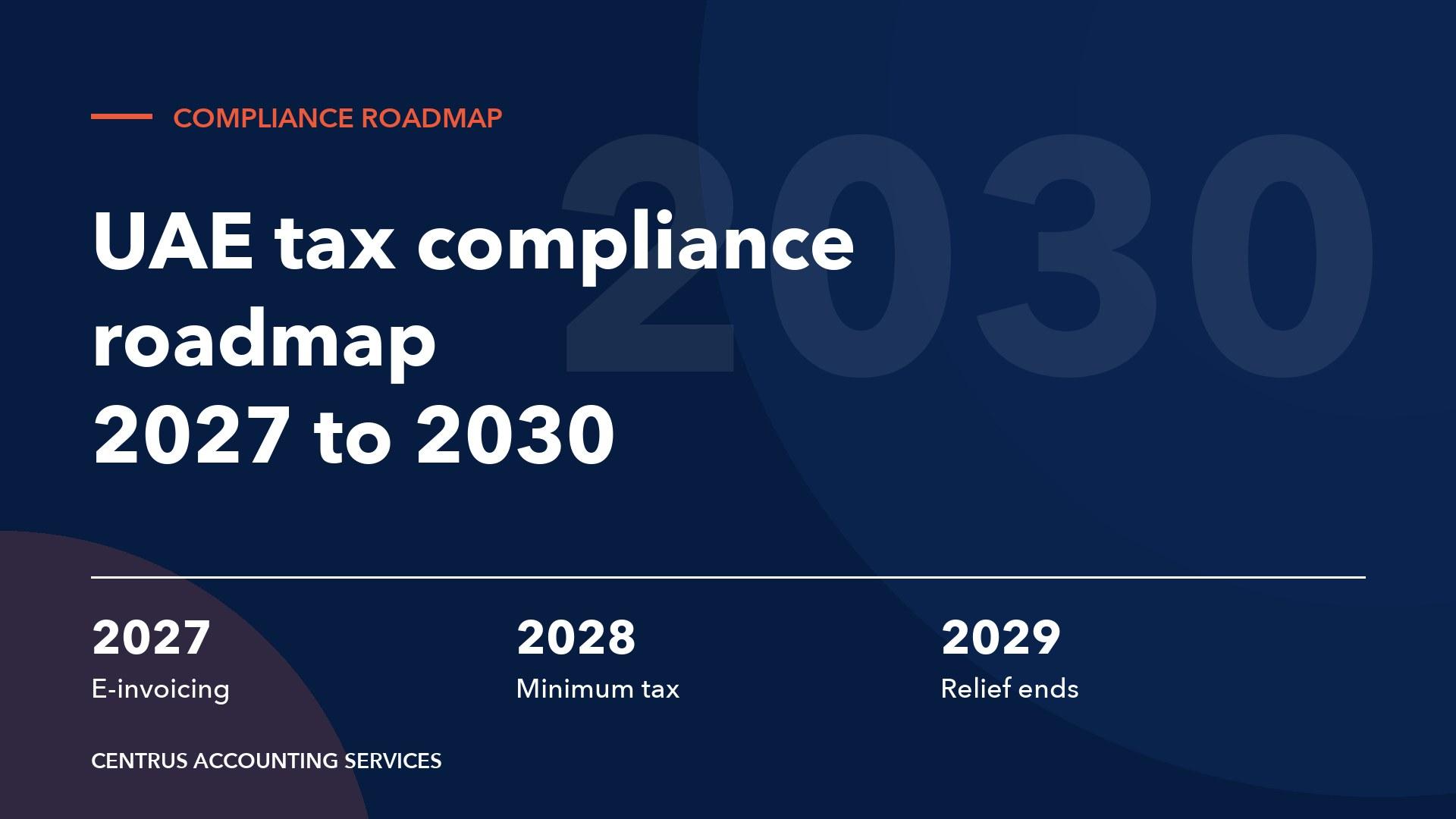
The main UAE tax changes for the next four years are already dated. This year-by-year roadmap covers e-invoicing in 2027, the minimum tax transition in 2028, the end of Small Business Relief in 2029, and what 2030 looks like.
Key points
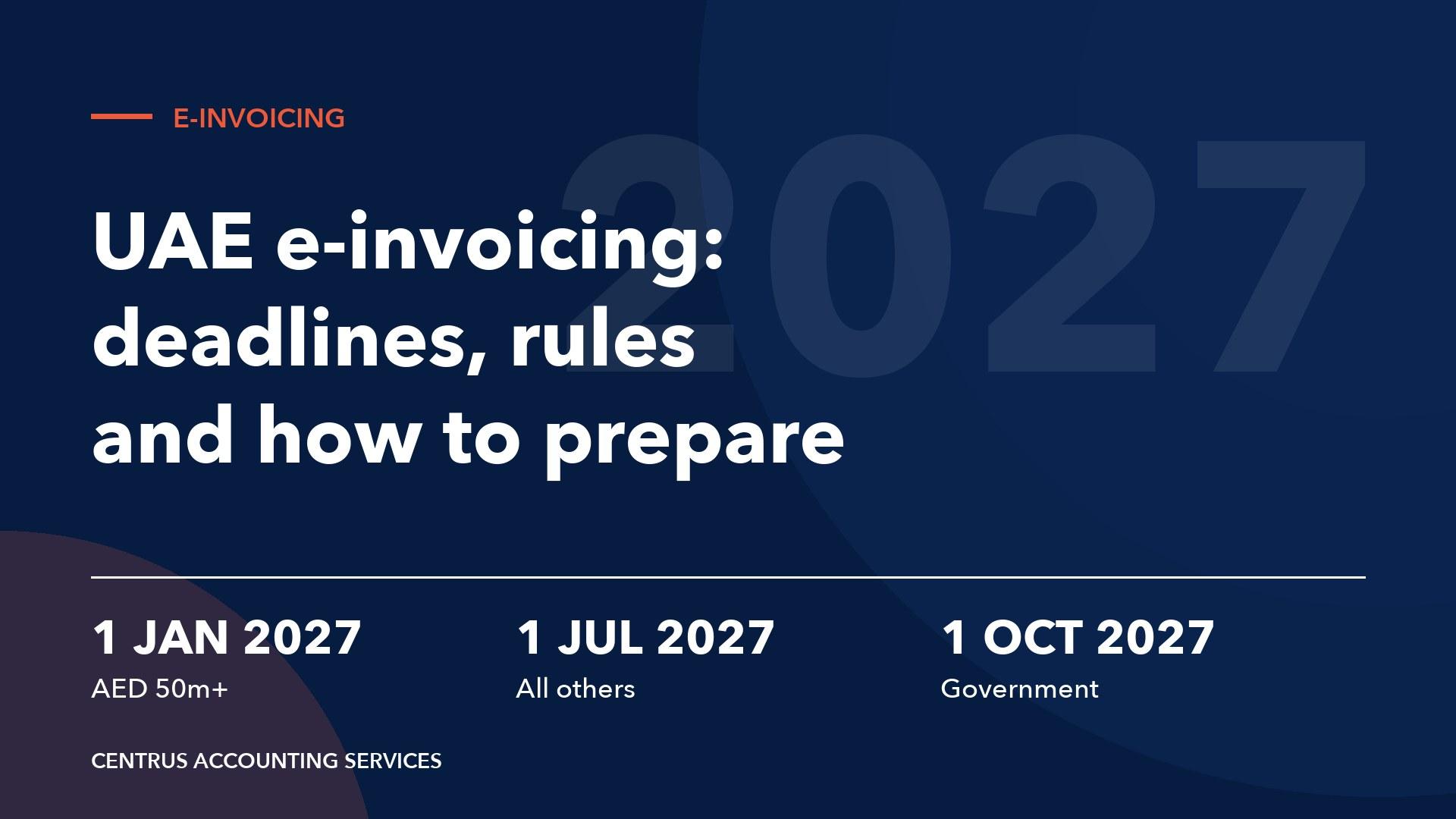
- 2027 is the year of e-invoicing: 1 January for larger businesses, 1 July for everyone else, 1 October for government entities.
- 2028 is when transitional reliefs for the 15% minimum tax on large multinationals begin to fall away.
- 2029 is the last year for which Small Business Relief can be claimed.
- 2030 is the first year small businesses should expect to compute and pay corporate tax in full.
Most tax planning in the UAE over the past three years has been reactive: a new law arrives, and businesses scramble to comply. The next four years are different. The main changes are already legislated and dated, which means a business can plan for them. This article sets out the calendar from 2027 to 2030 and what to do in each year.
Everything here reflects published rules as at November 2026. Where something is expected but not confirmed, we say so.
The starting point
The UAE now has a mature tax system by regional standards: VAT at 5% since 2018, corporate tax at 9% since 2023, excise tax on specific goods, and a 15% minimum tax for the largest multinational groups since 2025. The number of registered taxpayers shows how wide the net has become.
Source: Federal Tax Authority figures to the end of September 2025, as reported by Arabian Business.
Two things changed during 2026 that shape the years ahead. A new penalty regime took effect on 14 April 2026, charging late payment at 14% a year across VAT, excise and corporate tax. And from 1 January 2026 a taxpayer has five years to claim a refund or use a credit balance before it lapses.
The roadmap at a glance
- 1 January 2027E-invoicing, Phase 1
Mandatory for businesses with annual revenue of AED 50 million or more.
- 31 March 2027Service provider deadline
All remaining in-scope businesses and government entities must have appointed an accredited service provider.
- 1 July 2027E-invoicing, Phase 2
Mandatory for all other in-scope businesses.
- 30 September 2027Corporate tax return
Return and payment due for financial years ended 31 December 2026.
- 1 October 2027E-invoicing, Phase 3
Mandatory for in-scope government entities.
- 30 June 2028Minimum tax transitional relief ends
The transitional safe harbour and penalty relief for the Domestic Minimum Top-up Tax do not cover financial years ending after this date.
- 31 December 2029Small Business Relief ends
The last tax period end date for which the relief can be elected, unless it is extended again.
- 30 September 2030Last simplified return
Return due for the final calendar-year period covered by Small Business Relief.
2027: the e-invoicing year
From 2027 invoices between businesses must be issued and received as structured data through an accredited service provider on the Peppol network, with tax data reported to the FTA in near real time. A PDF will no longer be a valid invoice for in-scope transactions.
| Phase | Who | Appoint a provider by | Go live |
|---|---|---|---|
| 1 | Annual revenue of AED 50 million or more | 30 October 2026 | 1 January 2027 |
| 2 | All other in-scope businesses | 31 March 2027 | 1 July 2027 |
| 3 | In-scope government entities | 31 March 2027 | 1 October 2027 |
Missing a go-live date costs AED 5,000 for every month or part of a month of delay. Each invoice not issued electronically costs AED 100, capped at AED 5,000 a month.
What to do in 2027
- If you are in Phase 2, sign with a provider in the first quarter and test in the second.
- Clean your customer and supplier records. Wrong tax registration numbers are the most common reason invoices fail.
- Expect your large customers to ask whether you are ready before the law requires you to be.
- File your 2026 corporate tax return by 30 September 2027 if you have a December year end.
We cover the rules in detail in our UAE e-invoicing guide.
2028: data-driven enforcement and the minimum tax
By 2028 the FTA will hold a full year of transaction-level data for every in-scope business. That changes how audits work. Instead of asking for a sample of invoices, the authority can compare what a supplier reported with what a buyer claimed, across the whole population, and select cases where the two do not match.
The practical consequence is that the VAT return, the corporate tax return and the e-invoice data all have to agree. A business whose revenue in its corporate tax return differs from the total of its e-invoices should be able to explain why.
Large multinational groups
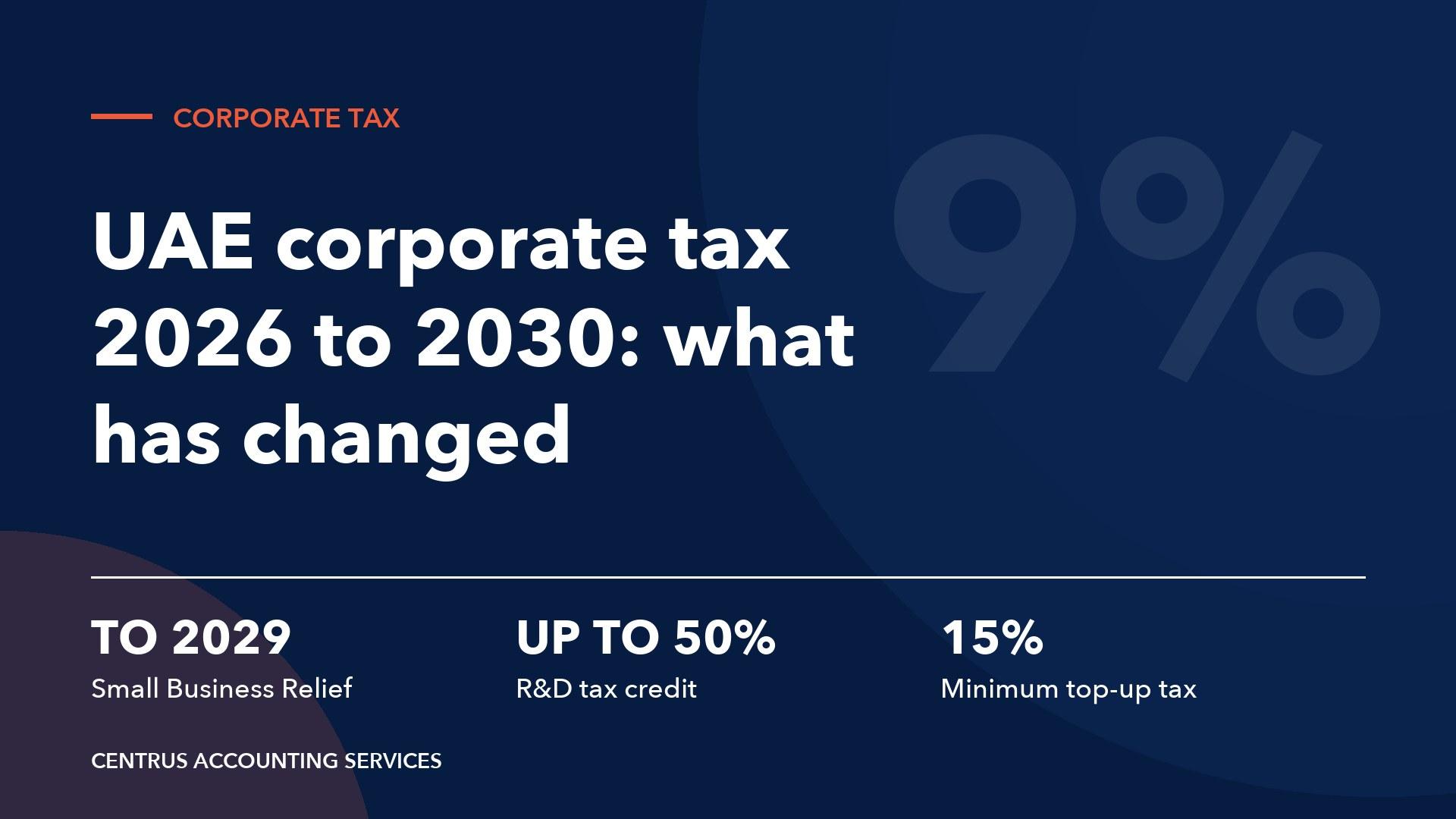
The Domestic Minimum Top-up Tax applies to groups with consolidated revenue of €750 million or more. During its first years, a transitional safe harbour based on country-by-country reporting can reduce the top-up tax to zero, and penalties for filing errors are relaxed where reasonable care was taken. Neither relief covers financial years ending after 30 June 2028. Groups relying on them need full effective tax rate calculations in place before then.
What to do in 2028
- Reconcile e-invoice totals to your VAT returns every quarter, and to your accounts at year end.
- Review whether any credit balance on your tax account is approaching the five-year limit.
- If you claimed the R&D tax credit for 2026 or 2027, make sure the project approvals and records support it.
2029: the last year of Small Business Relief
Small Business Relief lets a UAE resident business with revenue of AED 3 million or less elect to be treated as having no taxable income. It was extended in 2026 and now covers tax periods ending on or before 31 December 2029.
For a business with a calendar year end, 2029 is therefore the final year. Its first full computation under the standard rules will be for 2030.
Calculation: 0% on the first AED 375,000 and 9% on the remaining AED 625,000. Illustrative only; taxable profit is not the same as accounting profit.
What to do in 2029
- Run a trial tax computation for 2029 under the standard rules, even if you intend to elect for the relief, so you know what 2030 will cost.
- Review owner salaries, related-party charges and financing. These need to be at arm's length and properly documented once you are paying tax.
- Consider whether to stop electing for the relief a year early if you expect losses, so they can be carried forward.
- Watch for an announcement. The relief has been extended once already, but do not plan on a second extension.
2030: full corporate tax for small businesses
Unless the rules change, 2030 is the first year in which every small business computes taxable income in full: adjusting accounting profit for non-deductible expenses, applying the limits on entertainment and interest, and pricing transactions with owners and related companies at arm's length.
It is also a milestone for the wider economy. The UAE's current national strategies run to 2031, and businesses should expect tax policy to keep supporting them through targeted incentives such as the R&D credit, which the Ministry of Finance has described as a first phase.
What to do in 2030
- File the final Small Business Relief return for 2029 by 30 September 2030.
- Budget for corporate tax payments for the first time, including the cash flow effect nine months after year end.
- Make sure bookkeeping supports a full tax computation: clear expense categories, fixed asset records, and loan and related-party documentation.
What has not been decided
Good planning also means knowing what is still open. As at November 2026:
- E-invoicing for sales to consumers (B2C) has no start date. It is excluded until the Minister of Finance decides otherwise.
- The corporate tax and VAT rates remain 9% and 5%. No change to either has been announced.
- A second phase of the R&D tax credit has been signalled, but no details or dates have been published.
- Small Business Relief after 2029 depends on a future ministerial decision.
We would treat anything you read that gives a firm date for these as speculation until it appears in a published decision.
A year-by-year checklist
| Year | Small business (up to AED 3m) | Mid-sized business | Large business or group |
|---|---|---|---|
| 2027 | Appoint e-invoicing provider by 31 March; live 1 July | Appoint provider by 31 March; live 1 July; file 2026 return | Live on e-invoicing from 1 January; audited accounts; transfer pricing file |
| 2028 | Reconcile e-invoices to VAT returns | Reconcile e-invoices, VAT and corporate tax; review old credits | Minimum tax calculations before transitional relief ends |
| 2029 | Trial computation under standard rules; last year of relief | Review R&D credit opportunities and documentation | Full minimum tax compliance; review group structure |
| 2030 | First full corporate tax year; budget for payment | Business as usual, with cleaner data | Business as usual, with cleaner data |
Three habits that make all of this easier
- Keep the books current every month. Almost every deadline above is easy for a business whose records are up to date and hard for one that reconstructs them once a year.
- Keep documents for the full retention period. VAT records must generally be kept for five years and corporate tax records for seven.
- Fix errors when you find them. Under the current penalty rules a voluntary disclosure costs 1% of the tax for each month since it was due. Waiting only makes it more expensive.
How Centrus can help
We work with UAE businesses on bookkeeping, VAT, corporate tax and audit, and can build a compliance calendar for your company based on its year end, size and structure. Contact our team or see our full list of services. For more detail on corporate tax, read UAE corporate tax: what has changed and what to plan for.
Sources and further reading
- UAE Ministry of Finance: Electronic Invoicing Guidelines
- UAE Ministry of Finance: VAT law amendments effective January 2026
- Deloitte: UAE e-invoicing ASP appointment deadline extended
- EY: UAE issues Domestic Minimum Top-up Tax legislation
- Entrepreneur Middle East: UAE extends Small Business Tax Relief through 2029
- Al Tamimi & Company: UAE tax penalty reform effective 14 April 2026
- Arabian Business: FTA sees 651,000 corporate tax registrants
This article is general information, not professional advice. UAE tax and regulatory rules change, so confirm the current position with the Federal Tax Authority or speak to our team before acting on it.