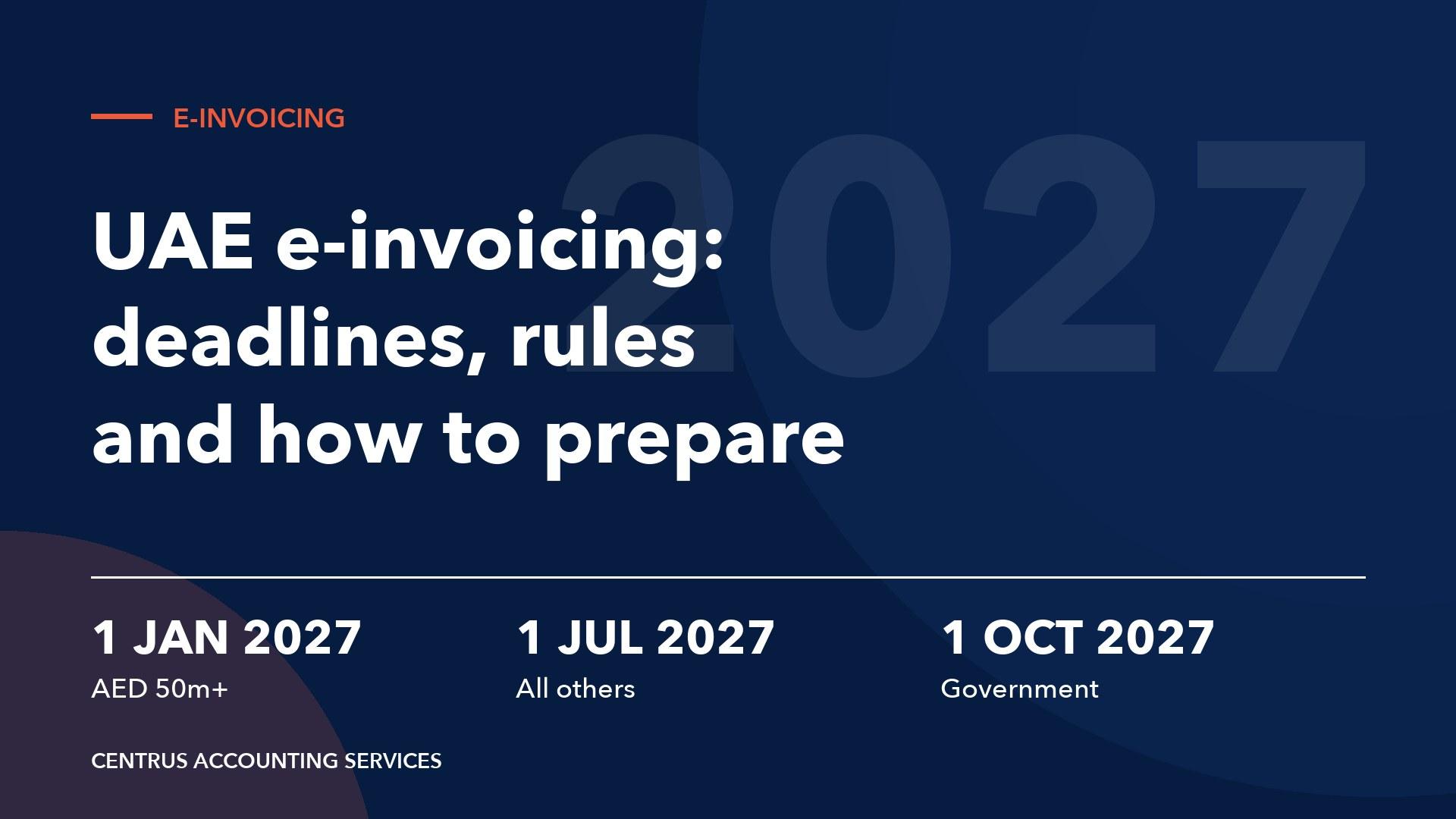
E-invoicing becomes mandatory in the UAE from 1 January 2027 for larger businesses and 1 July 2027 for everyone else. Here is who is in scope, every deadline, what the penalties are, and a step-by-step plan to get ready.
Key points
- E-invoicing becomes mandatory on 1 January 2027 for businesses with annual revenue of AED 50 million or more, and on 1 July 2027 for every other in-scope business.
- A PDF or scanned invoice is not an e-invoice. Invoices must be exchanged as structured data through a Ministry of Finance accredited service provider (ASP).
- Smaller businesses and government entities must appoint their ASP by 31 March 2027. Larger businesses should already have done so by 30 October 2026.
- Missing the deadline costs AED 5,000 for every month or part of a month of delay, on top of per-invoice penalties.
From 2027 the way UAE businesses bill each other changes for good. An invoice will no longer be a document that one company emails to another. It will be a structured data file that travels through an accredited network, is validated on the way, and is reported to the Federal Tax Authority (FTA) almost as soon as it is issued.
This guide sets out what the rules say as at November 2026, who is caught, the dates that matter, what non-compliance costs, and a practical plan for getting ready. It is written for owners, finance managers and accountants rather than for software vendors.
What e-invoicing means in the UAE
The UAE has adopted what the Ministry of Finance calls a decentralised continuous transaction control and exchange model, usually shortened to the five-corner model. It is built on the international Peppol network and uses a UAE-specific data format called PINT AE.
- Corner 1, the supplier, creates the invoice in its accounting or ERP system.
- Corner 2, the supplier's ASP, validates the data, converts it to PINT AE XML and sends it across the network.
- Corner 3, the buyer's ASP, receives the invoice and checks it.
- Corner 4, the buyer, receives the invoice data straight into its own system.
- Corner 5, the FTA, receives the tax data for the transaction from the service providers in near real time.
Three practical consequences follow. First, a PDF, a Word file or a photo of a paper invoice does not count. Second, you cannot connect to the network yourself; you need an accredited provider. Third, the tax authority sees your sales and your purchases at transaction level, so mismatches between what a supplier declares and what a buyer claims become visible quickly.
The legal framework
| Instrument | What it does |
|---|---|
| Ministerial Decision No. 243 of 2025 | Sets out the e-invoicing system: who and what is in scope, exclusions, and the obligations of issuers and recipients. |
| Ministerial Decision No. 244 of 2025 | Sets the phased implementation dates. The first ASP appointment deadline was later extended. |
| Cabinet Decision No. 106 of 2025 | Sets the administrative penalties for e-invoicing violations. |
| Federal Decree-Law No. 16 of 2025 | Amends the VAT Law with effect from 1 January 2026, including changes that support electronic invoicing. |
| Electronic Invoicing Guidelines (Ministry of Finance) | Operational guidance on the model, data requirements and onboarding. Updated during 2026. |
Who has to comply
The system applies to persons conducting business in the UAE, covering business-to-business (B2B) and business-to-government (B2G) transactions. Commentary on the decisions indicates that this is not limited to VAT registrants: a business that is not registered for VAT can still be in scope and will need a tax identification number to be onboarded.
What is excluded for now
- Business-to-consumer (B2C) sales. These stay outside the system until the Minister of Finance sets a date.
- Government entities acting in a sovereign capacity, where the activity does not compete with the private sector.
- International passenger air transport where an electronic ticket is issued, and related ancillary services.
- International transport of goods under an airway bill, for a temporary 24-month period.
- Financial services that are exempt or zero-rated for VAT.
- Any other transaction the Minister of Finance decides to exclude.
The timeline
- 1 July 2026Pilot and voluntary adoption
The pilot programme began with selected taxpayers, and any business that is technically ready may adopt e-invoicing voluntarily.
- 30 October 2026ASP deadline for larger businesses
Businesses with annual revenue of AED 50 million or more had to appoint an accredited service provider. This date was extended from 31 July 2026.
- 1 January 2027Phase 1 goes live
Mandatory e-invoicing for businesses with annual revenue of AED 50 million or more.
- 31 March 2027ASP deadline for everyone else
Businesses with revenue below AED 50 million, and government entities, must have appointed an ASP.
- 1 July 2027Phase 2 goes live
Mandatory e-invoicing for all other in-scope businesses.
- 1 October 2027Phase 3 goes live
Mandatory e-invoicing for in-scope government entities.
The extension of the first ASP deadline did not move the go-live date. Phase 1 still starts on 1 January 2027, and nothing published so far suggests the later phases will slip. Plan on the dates above.
What you must do once you are live
- Issue through an ASP. Tax invoices and tax credit notes for in-scope transactions must be created and transmitted electronically through your accredited provider.
- Issue on time. The invoice must be issued within 14 days of the date of supply, which matches the existing VAT rule.
- Receive electronically. As a buyer you must be able to receive e-invoices through your own ASP.
- Store the data in the UAE. E-invoice records must be kept in the UAE for the statutory retention period.
- Report system failures. If your system cannot issue or receive e-invoices, you must notify the FTA. Failing to do so carries a daily penalty.
- Keep your registered data current. Changes to the details held by your ASP, such as your trade name, address or TRN, must be notified to it.
Penalties
Cabinet Decision No. 106 of 2025 sets the fines. They apply to businesses that are legally required to use the system, not to those adopting it voluntarily.
| Violation | Penalty |
|---|---|
| Failing to implement the e-invoicing system or appoint an ASP by the deadline | AED 5,000 for each month, or part of a month, of delay |
| Failing to issue and transmit an e-invoice within the time limit | AED 100 per invoice, capped at AED 5,000 per calendar month |
| Failing to issue and transmit an electronic credit note within the time limit | AED 100 per credit note, capped at AED 5,000 per calendar month |
| Failing to notify the FTA of a system failure | AED 1,000 for each day, or part of a day, of delay |
| Failing to notify your ASP of changes to registered data | A daily penalty also applies; confirm the current amount with the FTA |
The fines themselves are modest for a large company. The larger exposure is commercial: a buyer whose supplier cannot send a valid e-invoice may struggle to support its input VAT recovery, and large customers are already writing e-invoicing readiness into supplier onboarding.
Is it worth more than the compliance cost?
There is not yet a published study that measures invoice processing costs in the UAE or the wider Gulf before and after e-invoicing. The mandate is too new here, and Saudi Arabia has not released cost data from its own rollout. International studies consistently report savings of 60% or more compared with paper-based processing, but those figures come from other markets with different wage levels, so we would not rely on them for a UAE budget.
What you can do is estimate it for your own business. The saving comes from staff time: less typing, fewer corrections, and less chasing of missing or mismatched invoices. The cost is the fee your accredited service provider charges. UAE pricing guides currently quote anything from under AED 1 to around AED 2 per invoice depending on volume and provider, so ask for a quote based on your actual numbers.
A worked example in dirhams
The figures below are an illustration, not a benchmark. Replace each assumption with your own.
| Manual or PDF invoicing | E-invoicing | |
|---|---|---|
| Invoices handled each month (sent and received) | 500 | 500 |
| Staff time per invoice | 12 minutes | 4 minutes |
| Staff cost per hour | AED 40 | AED 40 |
| Staff cost per invoice | AED 8.00 | AED 2.67 |
| Service provider fee per invoice | None | AED 1.00 |
| Total cost per invoice | AED 8.00 | AED 3.67 |
| Total cost per month | AED 4,000 | AED 1,835 |
AED per month
Illustration only, using the assumptions in the table above. This is not survey data; your own figures will differ.
On these assumptions the business saves about AED 2,165 a month, or roughly 54%. The result is most sensitive to how much staff time each invoice really takes today, so measure that before you rely on the number. A business that already has clean data and an integrated accounting system will save less; one that re-keys every supplier invoice by hand will save more.
For the tax authority the benefit is visibility. Countries that mandated e-invoicing earlier, including Italy from 2019 and Saudi Arabia in phases from December 2021, did so largely to close the gap between VAT that is due and VAT that is collected. The UAE collected VAT from more than half a million registrants last year, so even a small improvement in accuracy is significant.
For a business, the realistic gains are fewer manual keying errors, faster approval and payment, cleaner VAT returns, and far less time spent reconciling supplier statements. Those gains only appear if master data is clean before you go live.
A practical preparation plan
- Confirm your phase. Work out your annual revenue against the AED 50 million threshold and document how you reached the figure. If you are close to the line, take advice.
- Map your invoice flows. List every way an invoice leaves or enters the business: ERP, point of sale, spreadsheets, self-billing, intercompany recharges, credit notes and advance payments.
- Clean your master data. Customer and supplier TRNs, legal names, addresses and VAT treatment codes need to be complete and correct. This is where most projects lose time.
- Choose an ASP. Use the Ministry of Finance list of accredited providers. Compare integration with your accounting system, pricing per document, support in the UAE, and data residency.
- Check your accounting software. Confirm that your system can produce every data field PINT AE requires, and plan an upgrade or connector if it cannot.
- Test end to end. Run real scenarios through the test environment, including credit notes, discounts, foreign currency invoices and reverse-charge supplies.
- Train the people involved. Sales, procurement and finance staff all touch invoices. They need to know what changes on the day.
- Tell your customers and suppliers. Exchange Peppol participant details early so the first live invoice is not also the first test.
Suggested timing for a Phase 2 business
| When | What to have done |
|---|---|
| By end of December 2026 | Phase confirmed, invoice flows mapped, shortlist of ASPs |
| By end of February 2027 | ASP contract signed, master data clean-up under way |
| By 31 March 2027 | ASP formally appointed (legal deadline) |
| April to May 2027 | Integration built and tested with real scenarios |
| June 2027 | Staff trained, key customers and suppliers onboarded |
| 1 July 2027 | Live |
Common mistakes we are already seeing
- Treating it as an IT project. The data that fails validation is tax data. Finance has to own the project, with IT supporting.
- Leaving the ASP until the deadline. Providers have limited onboarding capacity, and integration takes weeks, not days.
- Forgetting inbound invoices. Receiving e-invoices from suppliers is as much an obligation as sending them.
- Ignoring intercompany and non-standard billing. Management fee recharges, retention invoices and self-billing are the transactions most often missed.
- Assuming a free zone or small business is exempt. There is no general exemption for either.
Frequently asked questions
Can I keep sending PDF invoices as well?
You can send a readable copy for convenience, but it is not the legal invoice. The structured e-invoice exchanged through the network is.
We are below AED 50 million. Can we start early?
Yes. Voluntary adoption has been open since 1 July 2026, and the e-invoicing penalties do not apply to voluntary users. Starting early gives you time to fix problems without a deadline over you.
Does e-invoicing replace our VAT return?
No. VAT returns are still filed in the usual way. What changes is that the FTA can compare your return with the transaction data it has already received.
What does it cost?
Pricing varies by provider. Expect an onboarding or integration fee and then a charge per document or a monthly plan. Ask for a total cost based on your actual invoice volume, inbound and outbound.
How Centrus can help
We help businesses confirm which phase applies, review invoice flows and VAT treatment, clean up master data, and work with their chosen provider through testing and go-live. If you would like a readiness review, contact our team or read more about our VAT consultancy service.
Sources and further reading
- UAE Ministry of Finance: Electronic Invoicing Guidelines
- EY: UAE Ministry of Finance publishes Ministerial Decisions on e-invoicing
- KPMG: UAE framework, scope and implementation of the e-invoicing system
- Deloitte: ASP appointment deadline extended, go-live remains 1 January 2027
- BDO: Cabinet Decision No. 106 of 2025 on e-invoicing penalties
This article is general information, not professional advice. UAE tax and regulatory rules change, so confirm the current position with the Federal Tax Authority or speak to our team before acting on it.